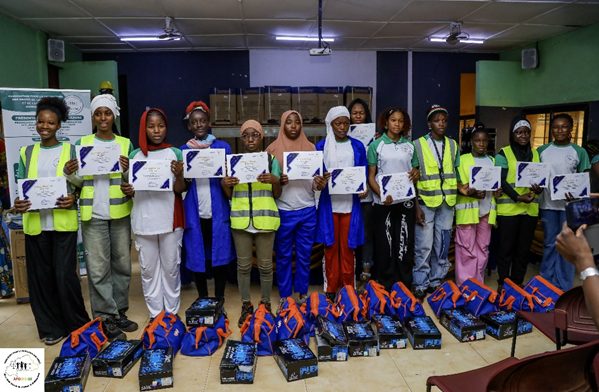
In Burkina Faso, where school dropout rates, youth unemployment, and forced displacement are common, access to appropriate vocational training can change lives. In Bobo-Dioulasso, the APDJFE, supported by IGNITE, has enabled 49 vulnerable young women, including several internally displaced persons, to gain economic independence by training in promising professions, often considered “reserved for men”
The official underemployment rate in Burkina Faso stands at 23.16%[1]. But behind this average, women (30.7%) are nearly twice as likely to be underemployed as men (16.9%). According to the INSD, this can be explained by socio-cultural constraints, with society placing greater emphasis on women’s role in domestic work.
Faced with this reality, in spring 2025 the Association for the Protection of the Rights of Girls and Children (APDJFE) launched an appeal offering vocational training to young women who had dropped out of school and were unemployed. Relayed by the regional directorate for Family and Solidarity, the appeal resulted in the selection of 49 young women aged between 17 and 19. “We set age and vulnerability criteria to give priority to those who are out of school and internally displaced,” insists APDJFE President Sawadogo Anasthasie.
Among them was Ourietou, 18, who had fled insecurity in the north of the country with her family and had not resumed her studies upon arriving in Bobo-Dioulasso. “I wasn’t studying, I wasn’t working. When I was lucky, I was called in for a few days of work sorting cashew nuts at harvest time”, she recalls. “Before this training, I spent a year sitting at home or looking for work. Due to lack of money, I left school at 16,” says Huguette.
[1] 2024 Report by the National Institute of Statistics and Demography (INSD) of Burkina Faso
Overcoming Prejudice and Social Pressure
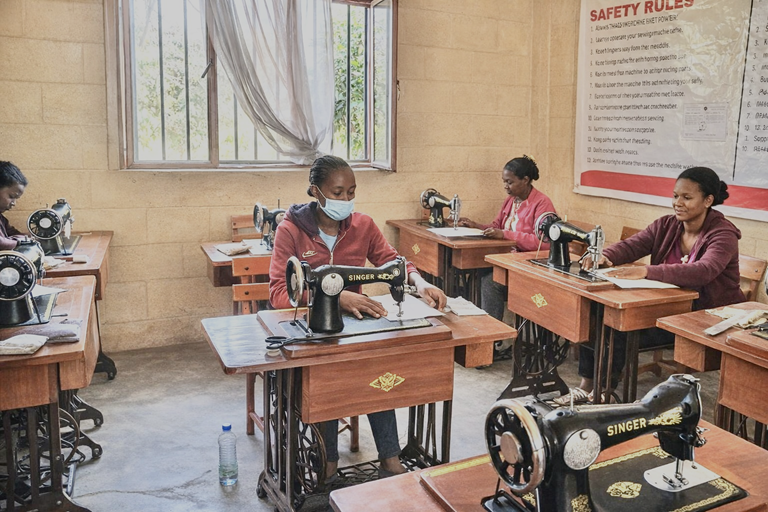
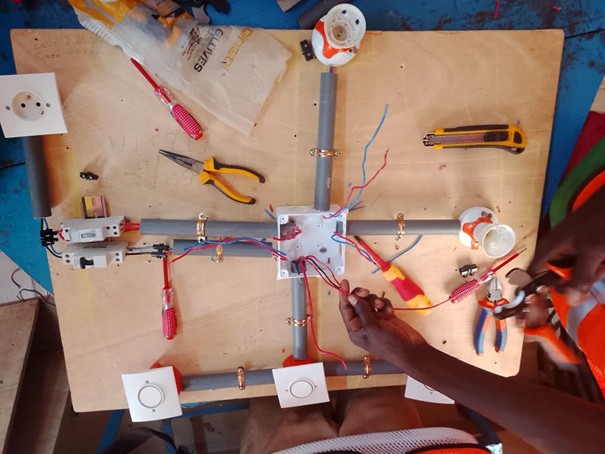
The training courses on offer included traditional subjects such as baking and computer graphics. However, in partnership with the training centre, the APDJFE has opened up access for young women to professions that go against established social norms, where their presence remains rare and is often discouraged.
This is how thirteen of them started training in the installation and maintenance of photovoltaic systems, and a dozen took the plumbing training. This choice obviously provoked reactions among the learners’ families and friends. “My father and older brother weren’t happy that I was learning plumbing. For them, it’s not a job for a woman. But I wanted to be free to do what I wanted. Now I can see many opportunities for my future,” recalls Ourietou.
One of the major challenges was therefore tackling gender bias. “People told me that plumbing wasn’t a job for girls,” says Aurélie, 20. Some participants even considered changing courses under pressure. Discussions were then organised to talk about the real opportunities offered by these professions, while leaving the choice up to the young women. They finally decided to stay and take up the challenge. “Women or men: we can all do the same job. Since I got my diploma, I’ve been working on construction sites and in schools, and I’m earning a living,” proudly says Aurélie today.
Some parents realised the opportunity for their daughters to train for a career with a future. “My parents supported me. They saw it as a way for me to earn money and help them financially,” says Huguette.
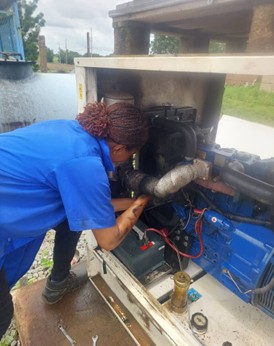
Opening Doors, Building Futures
During the first few weeks, “we faced challenges we hadn’t anticipated, such as the cost of communting for learners living in remote areas and the inadequacy of the training centre’s sanitary facilities,” explains Anasthasie. Thanks to the flexibility of the IGNITE grant, quick solutions were put in place, enabling all the girls to participate in the entire training programme from April to August 2025.
At the end of the course, each participant received a starter kit and a diploma to help them enter the job market. They were also given support in finding a two-month internship at the National Water and Sanitation Office in Bobo-Dioulasso and at the engineering camp of the 2nd military region, while returning home each evening. There, they gained their first practical experience – installing showers, toilets, washing machines, and solar panels – but also, and above all the self-confidence to overcome prejudice.
Four months after the end of the training, the effects are visible: emerging financial independence and plans for the future. Local authorities and the community have welcomed the initiative, encouraging its continuation and expansion.